
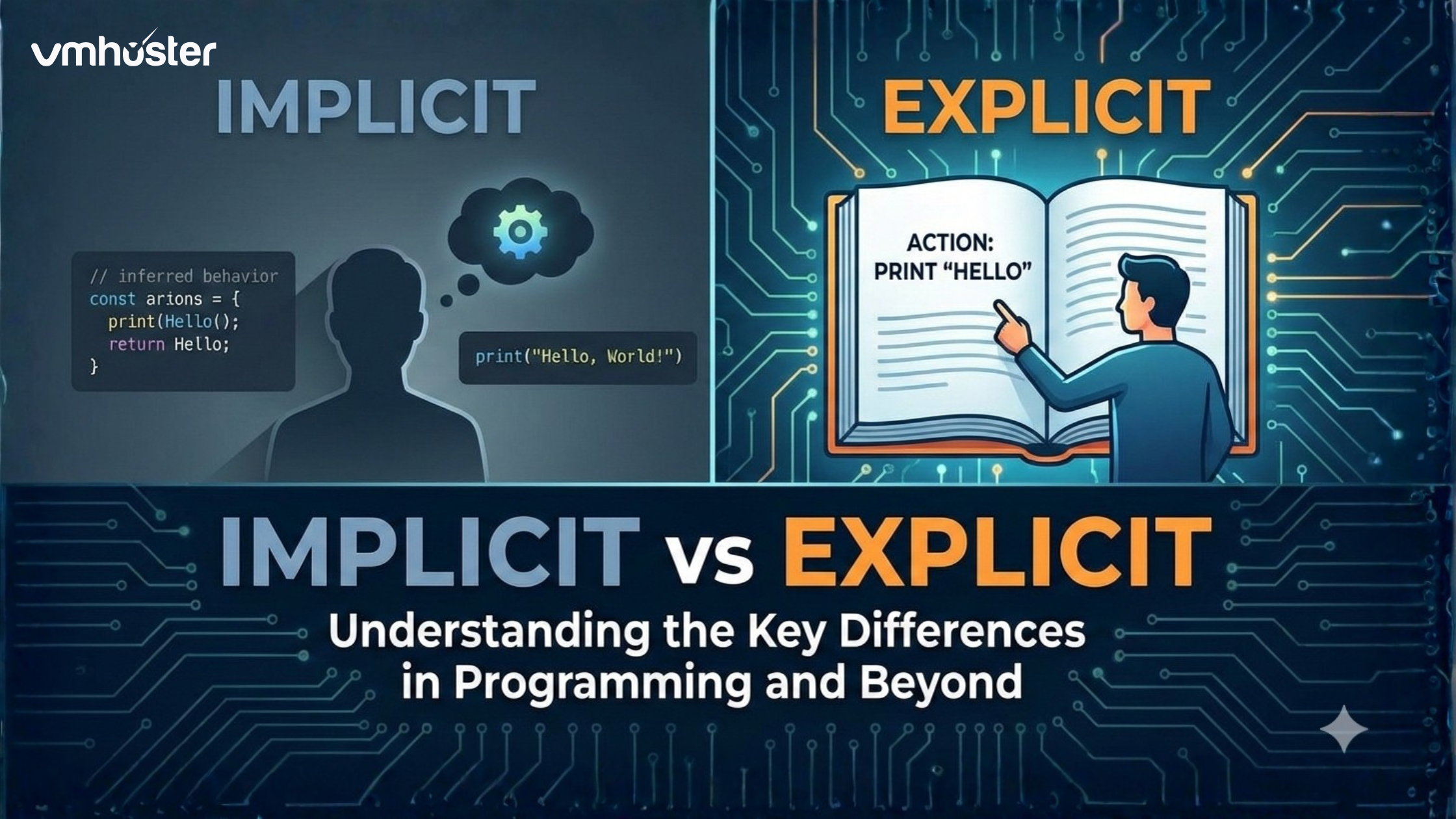
When I first started learning programming, I kept seeing these two words everywhere: “implicit” and “explicit.” My instructor would say things like “that’s an implicit conversion” or “you need to be explicit here,” and honestly, I had no clue what the difference was.
I nodded along, pretending to understand, until one day a simple bug in my code made everything click. I had written let result = "5" + 5 in JavaScript and expected 10, but got “55” instead. That’s when I learned the hard way about implicit type conversion—and why understanding the difference between implicit and explicit matters in programming and beyond.
Whether you’re a developer, a student, or just someone curious about these terms, this guide will break down everything you need to know in plain English, with real examples you can actually use.
What Do Implicit and Explicit Mean?
Let’s start with the basic definitions:
Implicit means something that is understood or implied without being directly stated or shown. It happens automatically, behind the scenes, without you needing to specify it.
Explicit means something that is clearly stated, shown, or expressed. It’s direct, obvious, and leaves no room for interpretation.
Think of it this way: If I hand you a cup of coffee without you asking for it, that’s implicit—I understood you wanted coffee without you saying so. If you say “Can I please have a cup of coffee?” that’s explicit—you directly stated what you want.
Simple, right? Now let’s see how this applies in different contexts.
Implicit vs Explicit in Programming
This is where these terms matter most for developers and anyone learning to code. Let me break down the key areas where you’ll encounter these concepts.
Type Conversion (Coercion)
Implicit Type Conversion happens when the programming language automatically converts one data type to another without you asking for it.
Here’s a real example in JavaScript that confused me for hours when I was learning:
javascript
let age = "25";           // This is a string
let nextYear = age + 1;   // What do you expect?
console.log(nextYear);    // Output: "251" (not 26!)
JavaScript implicitly converted the number 1 to a string and concatenated them instead of adding them mathematically. The language made an assumption about what I wanted.
Explicit Type Conversion is when you clearly tell the program to convert data types:
javascript
let age = "25";
let nextYear = Number(age) + 1;  // Explicitly convert to number
console.log(nextYear);            // Output: 26 (what we wanted!)
Now there’s no ambiguity. I explicitly told JavaScript “treat this as a number.”
Why it matters: Implicit conversions can cause sneaky bugs that are hard to track down. When I was building a calculator app during my internship, implicit type conversion caused calculations to fail silently for weeks before we caught it. Explicit conversions make your code clearer and more predictable.
Variable Declaration and Typing
Different programming languages handle variable types differently:
Implicit Typing (also called type inference):
python
# Python figures out the type automatically
name = "Alice"      # Python knows this is a string
age = 30            # Python knows this is an integer
Explicit Typing (declaring the type directly):
typescript
// TypeScript requires you to specify types
let name: string = "Alice";
let age: number = 30;
I learned TypeScript after JavaScript, and initially, I found explicit typing annoying. “Why do I need to write : string everywhere?” But after maintaining a large codebase, I realized explicit types catch errors before runtime—like a spell-checker for your code.
Function Returns
Implicit Return:
javascript
// JavaScript arrow function with implicit return
const double = (x) => x * 2;
Explicit Return:
javascript
// Explicit return statement
const double = (x) => {
  return x * 2;
};
Both do the same thing, but the explicit version makes it crystal clear what’s being returned. For simple functions, implicit returns are fine. For complex logic, explicit returns prevent confusion.
Memory Management
This one’s crucial if you’re working with languages like C or C++:
Implicit Memory Management (Garbage Collection):
javascript
// JavaScript - no need to manage memory
let data = new Array(1000000);
// JavaScript automatically cleans up when done
Explicit Memory Management:
c
// C language - you must manage memory
int* data = (int*)malloc(1000000 * sizeof(int));
// You MUST explicitly free it
free(data);
When I first learned C after Python, I forgot to free memory constantly, causing memory leaks. Explicit memory management gives you control but requires discipline.
Implicit vs Explicit in Communication
These concepts aren’t just for programmers—they apply to everyday communication too.
Implicit Communication relies on context, body language, and shared understanding:
Example: Your friend yawns repeatedly during your story. Implicitly, they’re telling you they’re tired or bored, even though they haven’t said so.
Explicit Communication states things directly and clearly:
Example: “I’m feeling tired right now, can we continue this conversation tomorrow?”
Real-World Scenario
I once worked on a project where my manager would implicitly suggest changes by saying “Hmm, interesting approach…” I initially thought he liked my work! Turns out, that was his implicit way of saying “this needs major revision.” After a miscommunication that delayed our launch, we adopted explicit feedback: “This needs revision because X, Y, Z.”
In professional settings, especially remote work or cross-cultural teams, explicit communication prevents costly misunderstandings. At VMHoster, we’ve learned that explicit documentation and clear communication protocols save hours of confusion, especially when managing distributed server infrastructure.
Implicit vs Explicit in Data and Databases
SQL Joins
Implicit Join (older style):
sql
SELECT * FROM users, orders
WHERE users.id = orders.user_id;
Explicit Join (modern best practice):
sql
SELECT * FROM users
INNER JOIN orders ON users.id = orders.user_id;
The explicit version clearly shows the join type (INNER) and the relationship. When reviewing code or debugging slow queries on VMHoster’s database systems, explicit joins save tremendous troubleshooting time.
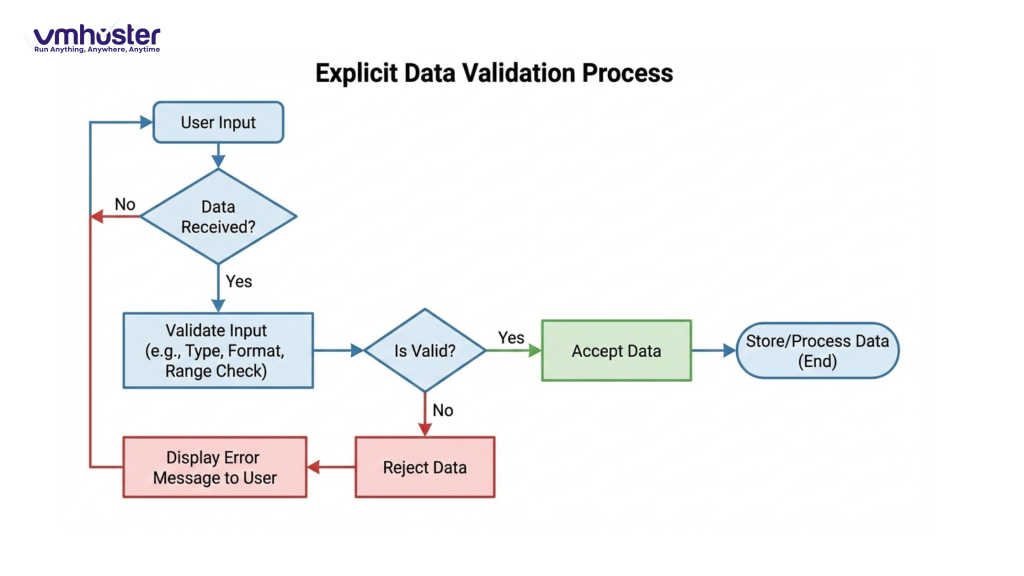
Data Validation
Implicit Validation: Assuming data is correct without checking
Explicit Validation: Actively checking data before processing
javascript
// Implicit - assumes email is valid
function sendEmail(email) {
  // send email...
}

// Explicit - validates email first
function sendEmail(email) {
  if (!email || !email.includes('@')) {
    throw new Error('Invalid email address');
  }
  // send email...
}
I learned this lesson after a production bug where invalid email addresses crashed our notification system. Explicit validation would have caught it immediately.
Implicit vs Explicit Permissions and Security
In server administration and security, this distinction is critical:
Implicit Permissions: Users inherit permissions based on their role or group membership automatically.
Explicit Permissions: You directly assign specific permissions to each user or resource.
Security best practice: Use the “principle of explicit denial”—explicitly deny dangerous actions rather than implicitly assuming they’re blocked. When configuring server permissions for secure hosting environments, explicit rules prevent security gaps.
When to Use Implicit vs Explicit
Here’s what I’ve learned through trial and error:
Use Implicit When:
✅ Readability is improved – Simple arrow functions with implicit returns
✅ Context is clear – Everyone understands the convention
✅ Performance matters – Some implicit operations are optimized
✅ The language/framework handles it well – Python’s type inference works great
Use Explicit When:
✅ Clarity is critical – Complex business logic needs explicit documentation
✅ Working in teams – Explicit code is easier for others to understand
✅ Debugging – Explicit operations are easier to trace
✅ Security matters – Explicit permissions prevent vulnerabilities
✅ Learning – Beginners benefit from seeing everything explicitly
Common Mistakes and How to Avoid Them
Mistake 1: Relying too heavily on implicit behavior
I once wrote Python code that relied on implicit integer division behavior. When the code ran on a different Python version, it broke because the implicit behavior changed. Lesson: Don’t assume implicit behavior is stable across versions.
Mistake 2: Being unnecessarily explicit
Early in my career, I wrote overly explicit code like:
javascript
if (isActive === true) {  // Redundant
  // do something
}
When this works fine:
javascript
if (isActive) {  // Cleaner
  // do something
}
Mistake 3: Mixing implicit and explicit styles inconsistently
Pick a style and stick with it. Mixed styles confuse everyone, including your future self.
Practical Tips for Developers
1. Enable strict mode: Many languages have strict modes that reduce implicit behavior:
javascript
'use strict'; // JavaScript strict mode2. Use linters: Tools like ESLint catch implicit issues before they become bugs.
3. Write self-documenting code: When in doubt, be explicit. Your teammates (and future you) will thank you.
4. Test edge cases: Implicit conversions often fail at edge cases—test them explicitly.
5. Document implicit behavior: If you must rely on implicit behavior, document why in comments.
For more on writing clean, maintainable code, check out our guide on best practices for server-side development.
The Philosophy Behind Implicit vs Explicit
There’s a famous principle in Python called “The Zen of Python” that states:
“Explicit is better than implicit.”
This doesn’t mean explicit is always better—it means when you have a choice, favor explicitness for clarity. However, different programming communities have different philosophies:
- Python: Favors explicitness
- Ruby: Embraces “magic” (implicit behavior)
- TypeScript: Offers both, lets you choose
- Go: Extremely explicit, almost no implicit behavior
Choose tools and languages that match your project’s needs and your team’s preferences.
Real-World Applications
In Web Development: Explicit API responses prevent client-side confusion. Instead of implicitly returning different data structures, explicitly define your API contract.
In Database Design: Explicit foreign key constraints prevent data integrity issues that implicit relationships might miss.
In DevOps: Explicit infrastructure-as-code (like Terraform) beats implicit server configurations that exist only in someone’s head. At VMHoster, we use explicit configurations for all infrastructure deployment to ensure reproducibility.
In Team Communication: Explicit requirements documents prevent project delays caused by implicit assumptions about features.
Conclusion
Understanding the difference between implicit and explicit has made me a better programmer, communicator, and problem-solver. The key takeaway? Both have their place, but when in doubt, be explicit.
Implicit behavior can make code elegant and concise, but it can also hide bugs and create confusion. Explicit behavior is clearer and safer, though sometimes more verbose.
As you grow in your career—whether in programming, system administration, or any technical field—you’ll develop intuition for when to use each approach. Start by being explicit, and gradually learn where implicit behavior makes sense.
Remember that coding example that started this article? Now you know why "5" + 5 gave me “55” instead of 10. That simple implicit type conversion taught me to always be explicit when precision matters—and that lesson applies far beyond just code.
What examples of implicit vs explicit behavior have you encountered? Have you been bitten by implicit conversions or saved by explicit type checking? Understanding these concepts is a journey, and every bug you encounter teaches you when to be explicit and when implicit is okay.