
When I first started exploring cloud infrastructure for my projects, Amazon Web Services (AWS) seemed like the only game in town. But here’s the thing, while AWS dominates the cloud market with roughly 32% market share, it’s not always the best fit for every business. Whether you’re looking to reduce costs, avoid vendor lock-in, or simply find a provider that aligns better with your specific needs, there are plenty of solid alternatives to AWS worth considering.
Let me walk you through the competitive landscape of cloud computing and help you understand which AWS competitors might be the perfect match for your infrastructure requirements.
Why Consider AWS Alternatives?
Before diving into specific competitors, it’s worth understanding why businesses actively seek alternatives to AWS. During my years working with different cloud platforms, I’ve noticed several recurring themes:
Cost management is often the biggest driver. AWS’s pricing model, while flexible, can become incredibly complex. I’ve seen companies shocked by their monthly bills because they didn’t optimize their resource usage properly. The “pay-as-you-go” model sounds great until you realize you’re paying for services you’ve forgotten about.
Vendor lock-in is another legitimate concern. Once you’re deeply integrated with AWS’s proprietary services like DynamoDB or Lambda, migrating away becomes a significant undertaking. Some businesses prefer platforms with better multi-cloud strategies from the start.
Then there’s regional availability and data sovereignty. Depending on where your customers are located, AWS might not have data centers in your preferred regions, or you might need a provider with specific compliance certifications.
Top AWS Competitors and Alternatives
1. Microsoft Azure
If there’s one true heavyweight competitor to AWS, it’s Microsoft Azure. I’ve worked with several enterprise clients who chose Azure primarily because of their existing Microsoft ecosystem—think Office 365, Active Directory, and Windows Server infrastructure.
What makes Azure stand out:
- Seamless integration with Microsoft products
- Strong hybrid cloud capabilities with Azure Arc
- Excellent for enterprises already using Microsoft licensing
- Competitive pricing, especially for Windows-based workloads
Azure has been growing aggressively, currently holding about 23% of the cloud market. The learning curve isn’t too steep if you’re already familiar with Microsoft technologies.
2. Google Cloud Platform (GCP)
Google Cloud might be third in market share (around 11%), but it’s a powerhouse for specific use cases. When I worked on a machine learning project last year, GCP’s AI and data analytics tools were simply unmatched.
GCP’s strengths include:
- Best-in-class data analytics and machine learning services
- Competitive pricing with sustained use discounts
- Superior Kubernetes support (they invented it, after all)
- Strong performance in networking and global infrastructure
Google also tends to be more developer-friendly with cleaner APIs and better documentation in my experience. If your workload involves big data, analytics, or AI, GCP deserves serious consideration.
3. IBM Cloud
IBM might not be the first name that comes to mind, but they’ve carved out a strong position, especially in regulated industries. After acquiring Red Hat, IBM’s hybrid cloud story became much more compelling.
Why businesses choose IBM Cloud:
- Industry-leading compliance certifications
- Strong focus on hybrid and multi-cloud deployments
- Excellent for mainframe integration
- Red Hat OpenShift integration for containerized workloads
I’ve noticed IBM Cloud particularly popular among financial services and healthcare organizations where compliance and data security are non-negotiable.
4. Oracle Cloud Infrastructure (OCI)
Oracle came late to the cloud party, but they’re making up for lost time with aggressive pricing and impressive performance. If you’re running Oracle databases (and many enterprises are), OCI offers some compelling advantages.
OCI highlights:
- Up to 30% cheaper than AWS for many workloads
- Exceptional database performance
- Automated database management features
- Strong commitment to supporting Oracle workloads
One thing that surprised me about OCI is their willingness to undercut AWS on price while delivering solid performance benchmarks.
| Provider | Configuration (2 vCPU, 8 GB RAM) | Monthly On-Demand Price (Approx.) |
| AWS (Baseline) | 2vCPU, 8GB RAM | $70.08 |
| Azure | 2vCPU, 8GB RAM | $70.08 |
| GCP | 2vCPU, 8GB RAM | $71.90 |
| OCI | 2vCPU, 8GB RAM | $38.69 |
5. DigitalOcean
Here’s where we get into alternatives that cater to different audiences. DigitalOcean isn’t trying to compete with AWS feature-for-feature. Instead, they’ve focused on simplicity and developer experience.
What I love about DigitalOcean:
- Incredibly straightforward pricing (no surprise bills)
- Simple, intuitive interface
- Perfect for startups and small to medium businesses
- Great community and documentation
When I’m spinning up a personal project or helping a startup get off the ground, DigitalOcean is often my go-to recommendation. Their $5/month droplets are perfect for getting started without breaking the bank.
6. Linode (now Akamai)
Linode has been around since 2003, and they’ve built a loyal following among developers who appreciate their no-nonsense approach to cloud hosting. Since Akamai acquired them, they’ve gained even more edge computing capabilities.
Linode’s advantages:
- Transparent, predictable pricing
- Excellent performance-to-cost ratio
- Strong focus on Linux-based workloads
- 24/7 human support that actually knows what they’re talking about
I’ve used Linode for several client projects, and the reliability has been rock-solid. Their support team once helped me troubleshoot a networking issue at 2 AM—that’s the kind of service that builds loyalty.
7. VMhoster
While researching cloud alternatives, I came across VMhoster—a provider that’s been quietly building a solid reputation for managed cloud solutions. They focus on delivering high-performance infrastructure with a personal touch that’s often missing from larger providers.
What caught my attention about VMhoster is their approach to managed services. They offer competitive pricing on VPS and dedicated server solutions, with data centers strategically located to serve various regions. Their emphasis on customer support and flexible configurations makes them worth considering, especially if you’re looking for a more hands-on provider that can tailor solutions to your specific requirements.
8. Vultr
Vultr is another developer-favorite that’s been growing steadily. They’ve positioned themselves as a high-performance, affordable alternative with a global presence.
Vultr’s selling points:
- 25+ data center locations worldwide
- One-click app deployments
- Excellent bare metal server options
- Competitive pricing starting at $2.50/month
I particularly appreciate their bare metal offerings—sometimes you need dedicated hardware without the hassle of managing physical servers yourself.
9. Alibaba Cloud
If you’re doing business in Asia, Alibaba Cloud (Aliyun) is impossible to ignore. They’re the dominant player in China and expanding rapidly in other Asian markets.
Why consider Alibaba Cloud:
- Unmatched presence in China and Southeast Asia
- Competitive pricing
- Growing global footprint
- Strong e-commerce and retail solutions
One caveat: if you’re not operating in Asia, the language barriers and documentation challenges might outweigh the benefits.
10. Hetzner Cloud
Hetzner is a German provider that’s gained significant traction in Europe. They’re known for exceptional value and straightforward pricing.
Hetzner Cloud benefits:
- Extremely competitive pricing
- Strong data privacy compliance (GDPR-focused)
- Excellent network performance
- Growing number of European data centers
I’ve deployed several European projects on Hetzner, and the cost savings compared to AWS were substantial—we’re talking 50-70% cheaper for equivalent resources.
Specialized AWS Alternatives by Use Case
For Developers and Startups
If you’re a developer working on side projects or running a startup, you probably don’t need the complexity of AWS. Consider:
- DigitalOcean: Simple, affordable, great documentation
- Vultr: Fast deployment, good performance
- Linode: Reliable, straightforward pricing
For Enterprise Workloads
Large organizations with complex requirements should look at:
- Microsoft Azure: Best for Microsoft-centric environments
- IBM Cloud: Ideal for regulated industries
- Oracle Cloud: Perfect if you’re running Oracle databases
For AI and Machine Learning
Data scientists and ML engineers often prefer:
- Google Cloud Platform: Industry-leading ML tools
- Microsoft Azure: Strong AI services and integration
For Multi-Cloud Strategy
If you’re building for flexibility:
- Google Cloud Platform: Strong Kubernetes support
- IBM Cloud: Red Hat OpenShift integration
- Oracle Cloud: Good multi-cloud management tools
How to Choose the Right AWS Alternative
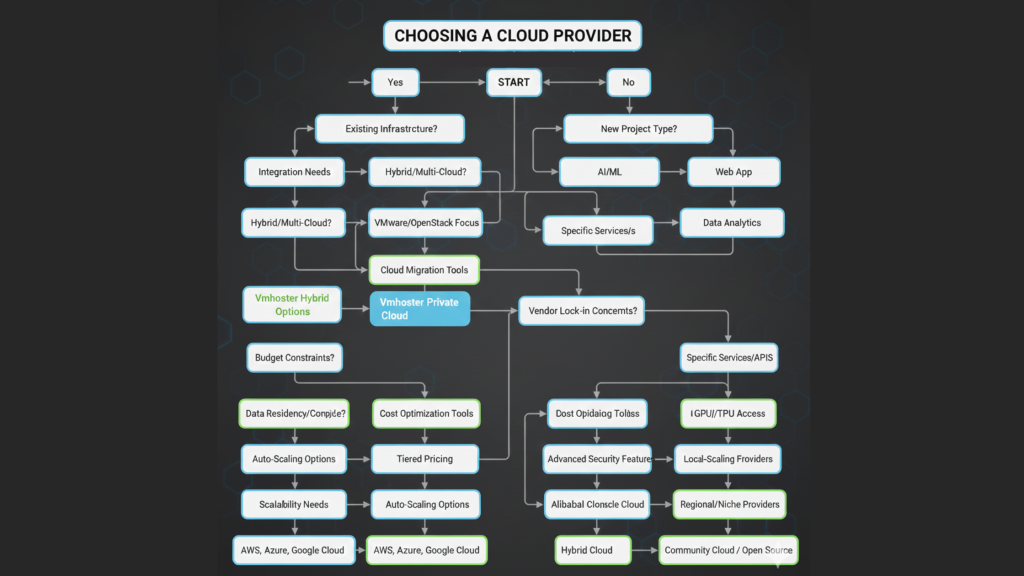
After evaluating dozens of migrations and new cloud deployments, here’s my practical framework for choosing:
1. Assess your actual needs: Don’t pay for features you’ll never use. AWS offers 200+ services—do you really need them all?
2. Calculate total cost: Look beyond compute costs. Consider bandwidth, storage, support plans, and hidden fees. Use pricing calculators religiously.
3. Evaluate your team’s expertise: If your team knows Azure inside out, switching to GCP just for slightly better pricing might not be worth the learning curve.
4. Consider your growth trajectory: Will your provider scale with you? DigitalOcean is great for startups, but you might outgrow it eventually.
5. Test before committing: Most providers offer free trials or credits. Spin up test environments and see how they perform with your actual workloads.
Real-World Migration Considerations
I’ve been involved in several AWS migrations, and here’s what I’ve learned the hard way:
Data egress costs can be brutal. AWS charges significant fees for moving data out. Budget for this if you’re migrating large datasets. Some companies I’ve worked with spent tens of thousands of dollars just getting their data out of AWS.
Not everything translates directly. AWS Lambda doesn’t work exactly like Azure Functions or Google Cloud Functions. You’ll need to refactor code, update deployment scripts, and retrain your team.
Managed services are the hard part. If you’re using RDS, DynamoDB, or other managed services, finding exact equivalents elsewhere takes research. Sometimes you’ll need to manage more infrastructure yourself.
The Multi-Cloud Approach
Here’s something I’ve seen work really well: you don’t have to choose just one provider. Many sophisticated organizations use multiple clouds strategically:
- Primary workloads on one provider
- Disaster recovery on another
- Specific services where each provider excels
This approach provides resilience and flexibility, though it does increase management complexity. Tools like Kubernetes and Terraform make multi-cloud strategies more manageable than ever.
Looking Ahead: The Future of Cloud Competition
The cloud market is far from settled. According to Gartner’s latest research, cloud spending continues growing at double-digit rates, and competition is intensifying.
We’re seeing interesting trends:
- Edge computing is pushing providers to expand geographically
- Sustainability is becoming a differentiator (Google claims 100% renewable energy)
- Specialized providers are emerging for specific industries and use cases
- Pricing pressure continues as providers compete more aggressively
Conclusion: AWS Isn’t Your Only Option
Look, AWS is an incredible platform. It’s comprehensive, reliable, and continuously innovating. But it’s not the only game in town, and for many use cases, it’s not even the best option.
Whether you’re concerned about costs, seeking better integration with your existing stack, or simply wanting to avoid vendor lock-in, the alternatives I’ve covered offer legitimate paths forward. I’ve personally worked with most of these platforms, and each has its strengths.
My advice? Don’t choose based on market share alone. Evaluate your specific requirements, run some proof-of-concept projects, and make an informed decision based on what actually matters to your business.
The cloud landscape is more competitive and diverse than ever—and that’s great news for customers. Competition drives innovation, improves service, and keeps prices in check.
What’s been your experience with AWS alternatives? I’d love to hear about your journey in the comments below.
Related Resources:
- Compare Cloud Provider Pricing: A Complete Guide
- Optimizing Cloud Costs: Best Practices for Any Provider
External Resources: